What Is a Mokoro? The Traditional Dugout Canoe Explained
The channel is often narrower than the boat is long, and the water sits inches below the gunwale. A mokoro is the oldest way to move through the Okavango Delta and still the best one.
A mokoro day pairs a poled canoe ride with an island walk. Start from Maun for a day visit, or compare two-night camping if you want more time on the water. Explore Mokoro Day From Maun
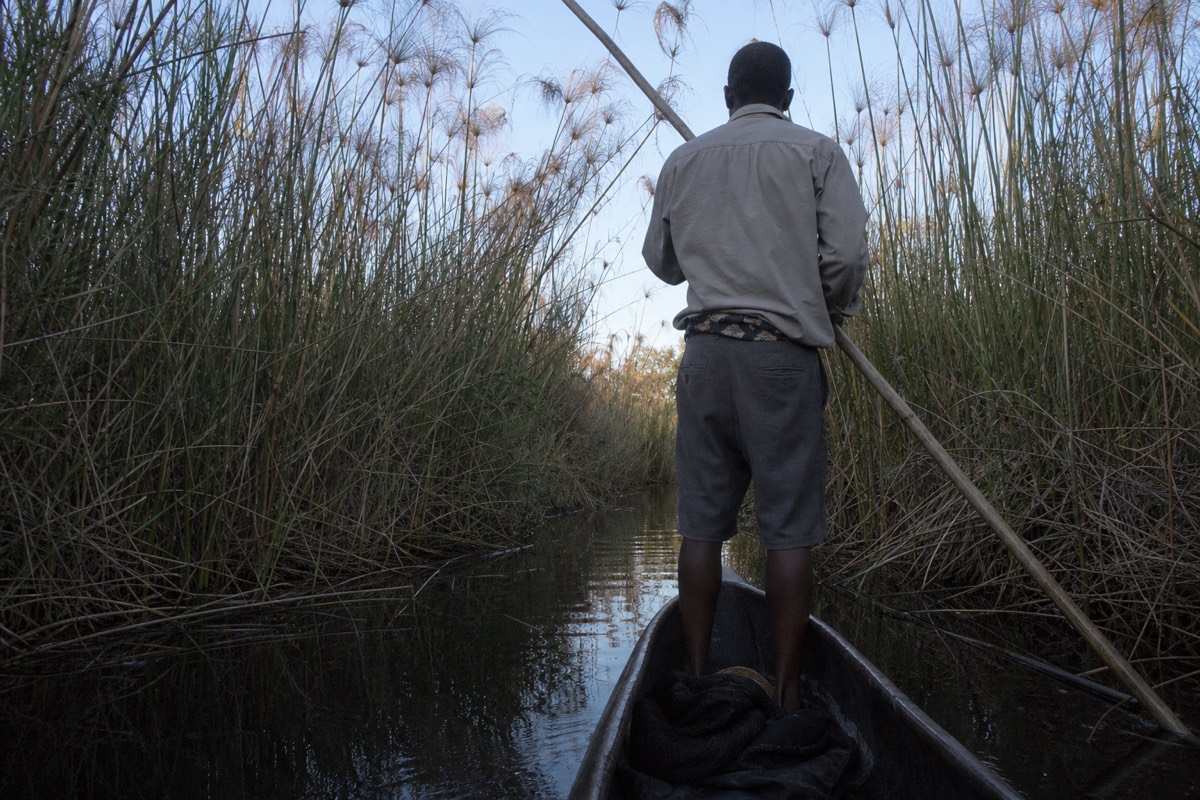
The channel is frequently narrower than the boat is long. That is the detail people remember: papyrus closing in on both sides, black water an inch or two below the gunwale, and no sound except birds and a pole pushing off the bed. Before anyone sells you a ride in one, here is what the boat actually is.
What is a mokoro?
A mokoro is a flat-bottomed dugout canoe used to travel the shallow channels of the Okavango Delta. It was originally carved from a single tree, jackalberry among them, and today is often made of fibreglass instead, and it is poled from the stern by a standing guide rather than paddled.
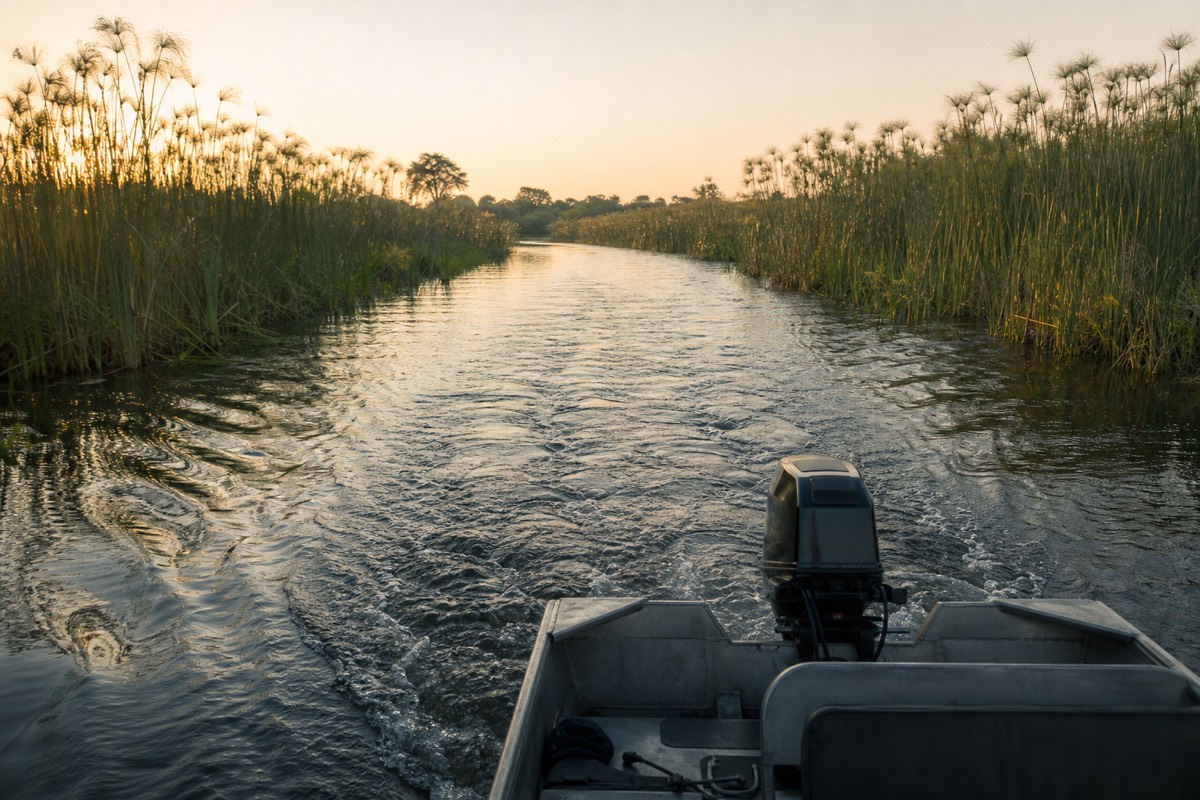
The fibreglass substitution is a conservation decision, not a downgrade. Hollowing a mokoro consumes a mature hardwood, and demand from tourism would take far more trees than the delta can spare, so most working boats now use a moulded hull with the same flat bottom and the same behaviour in shallow water. Nothing about the trip changes. What makes a mokoro trip is the poler, not the material it is made from, and the boat is still the only practical way to move through the flooded channels of northern Botswana.
How is a mokoro propelled, and what does the poler do?
A poler stands in the stern and pushes the boat forward with a long pole against the bed, punting rather than paddling. Passengers do nothing at all. The poler navigates by channel knowledge rather than visible landmarks, and works as your guide to the birds, the plants and the animal behaviour as well as your boatman.
There are no signs out there, no roads, and the channels themselves change as the water rises and falls. A poler is reading depth through the pole, remembering which routes stay open at this water level, and watching ahead constantly. On the full-day trip with a delta-born poler, from $181 per person, that local knowledge is the product.
What is riding in a mokoro actually like?
Two passengers sit or lie very low, inches above still, black water, with papyrus on both sides. The pace is a slow walk. It is silent, there is no engine and no paddling, and most people stop talking within a few minutes and stay quiet for the rest of the trip.
You are at the level of the water lilies, so a frog on a leaf passes at eye height. Sun on open water is unfiltered, which matters more than people expect, and there is nowhere to put anything you cannot hold. The eight-hour all-inclusive mokoro day out of Maun, from $200 per person, builds transfers, meals and park fees around that core of channel time.
| Activity | What it gives you | When it runs | Who it suits |
|---|---|---|---|
| Mokoro | Silence, waterline eye level, close birds and hippos | Best June to August, when channels are full | No paddling; minimum age and mobility requirements vary by operator |
| Motorboat | Wider channels, ground covered, elephants swimming | Where permanent deeper water holds up | Photographers who want reach and a stable platform |
| Open 4x4 drive | Predators, large herds, distance at dawn and dusk | Year round, strongest May to October | First safaris and anyone chasing the Big Five |
| Walking safari | Tracks, plants, scale on foot, small detail | Daylight, on dry islands, with a tracker | Steady walkers who want detail over distance |
Camps normally combine all four across a day rather than making you choose; the table is what each one is good at.
Why does a mokoro work so well for wildlife?
The low profile is the trick. From waterline height the boat does not read as a threat, so animals at the water's edge often ignore it, and with no engine there is nothing to push them off. That combination puts you closer to relaxed animals than a vehicle usually manages.
Red lechwe wade in the shallows, elephants cross between islands, and fish eagles and kingfishers work the channel edges. Hippos use the same waterways, which is the honest risk, and it is handled by the poler reading the water ahead continuously: they know the territorial ranges of individual animals and which channels those animals favour at different hours. Local knowledge is the safety system here, which is part of how safe the delta actually is.
Who are the polers, and where does the money go?
The Okavango Mokoro Community Trust employs local polers from villages around the delta and channels income directly into communities that have depended on this ecosystem for generations. It is a long-standing cooperative rather than a marketing label, and the polers on the community trips grew up on these channels.
The same trust runs two nights of mokoro camping on an island, fully catered, from $850 per person, with dawn mokoro sessions and afternoon bush walks. Its daily capacity is deliberately limited to protect the ecosystem, which is the real reason dry-season dates go early.
How long is a mokoro trip, and what does it cost?
A standard mokoro excursion runs 2 to 3 hours, a full-day version with an island picnic runs 4 to 6 hours, and multi-day mokoro camping trips go further into the delta. Arranging your own poler at a public launch point costs roughly USD 50 to 100 a day.
Those public access points are real but demanding: Xakanaxa, and the polers' trust near Mababe Gate, both of which need your own high-clearance vehicle and hours of sandy driving to reach.
| Format | Duration | Typically includes | From |
|---|---|---|---|
| Standard excursion | 2 to 3 hours | Poler, channel drift, wildlife stops | Part of a camp day |
| Full day with island picnic | 4 to 6 hours | Transfers, meals, park fees, short nature walk | $181 to $200 |
| Multi-day mokoro camping | 2 nights upward | Island bush camp, catering, dawn mokoro, bush walks | $850 |
| Self-arranged at a public launch | 1 to 3 hours | Poler and boat only, no meals or transfers | USD 50 to 100 a day |
Planning allowances rather than quotes: the current starting price sits on each live listing, and self-arranged rates are set at the launch point.
When can you ride one, and who should skip it?
A mokoro needs water. June to August is peak, because the Angolan flood reaches Botswana in May and June and peaks in July and August. In the green season, low water limits where a mokoro can physically go, so the season decides the route as much as the operator does.
That timing is counter-intuitive enough to be worth understanding before booking, and the flood-cycle record for this World Heritage wetland lays out the lag. Our own month-by-month view of which months carry enough water for the channels goes further.
Skip a mokoro if sitting at floor level in a narrow hull for two hours would be uncomfortable, or if getting low into a boat from a bank is a problem. Skip it too if you want excitement: there is no speed, no rapids and nothing happening except the delta. That is the appeal, and it is not for everyone. It is also why Okavango Delta Botswana Tours lists the community mokoro trips beside the private-concession safaris rather than pretending one replaces the other.