Best Time to Visit the Okavango Delta: A Month by Month Guide (2026)
The Okavango floods in the middle of Botswana's dry winter, because the rain that fills it falls in Angola six months earlier. That inversion decides everything about when to go.
Your month, activity and location matter together. Review operator conditions for your dates; the month selector favours shorter, more flexible trips in rainy months. Explore Two Nights Of NG32 Mokoro Camping
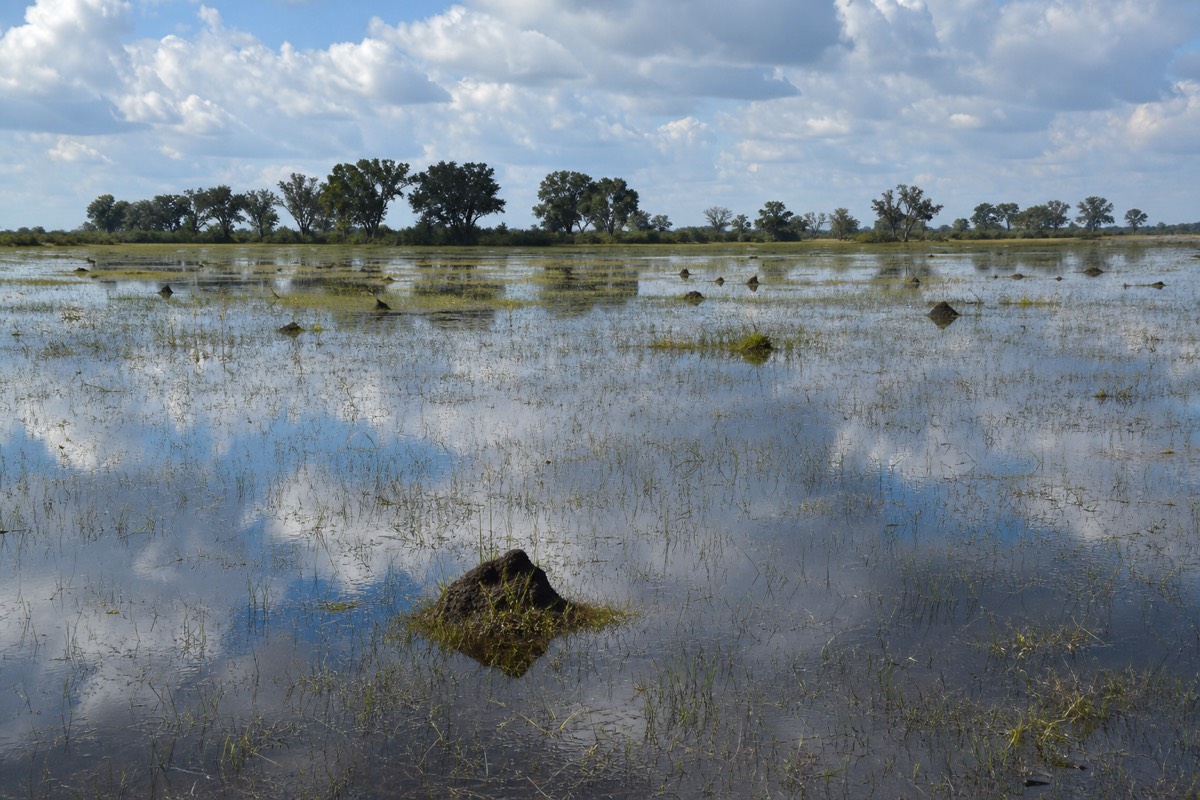
The Okavango Delta is at its fullest in the middle of Botswana's dry winter, and at its lowest when it is actually raining. That is not a quirk of local weather. The water that floods the delta falls as rain in Angola, roughly 1,200 kilometres upstream, and it takes months to arrive, so peak flood lands in July and August while Botswana has not seen a drop since April. Two rainy seasons, six months out of phase, is the whole story of when to visit this place. Get it wrong and you book a canoe trip into a channel with no water in it. The team at Okavango Delta Botswana Tours works this calendar every day, so here it is, month by month, with the mechanic behind it explained first.
Two rainy seasons, six months apart: why the delta is fullest when Botswana is driest
Water levels shown are the typical annual pattern, not a forecast. The flood arrives earlier or later by several weeks from year to year depending on the previous Angolan wet season.
When is the best time to visit the Okavango Delta?
June to August is the strongest window overall: peak water for canoe and boat trips, plus excellent game viewing because animals concentrate on the remaining permanent channels. The wider dry season, May to October, is the best stretch for wildlife. November to April is the green season, with low water, lush scenery, superb birding, fewer visitors and lower prices.
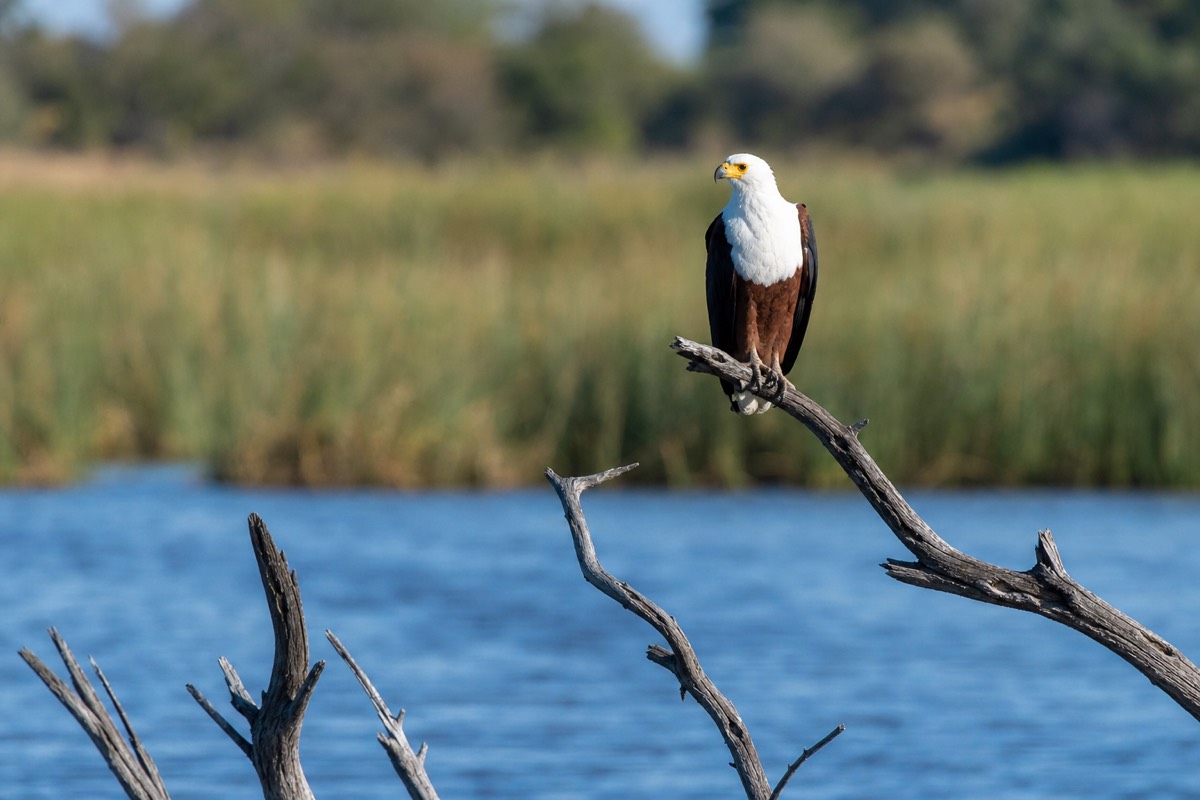
That is the short answer, and it is honest, but it hides a decision. If you came for the classic image of the delta, a dugout canoe sliding through papyrus with water to the horizon, then June, July and August are not merely better, they are a different destination from February. If you came for predators on open ground, big skies and a quiet camp at a softer price, the green season earns its place. And if you came for birds, both halves of the year are excellent for completely different reasons.
What almost nobody works out from a weather chart is why the seasons behave this way, which starts with where the delta actually sits on the map and where its water comes from. The other half of the decision is money, because peak season is also peak pricing, and the gap between a green-season trip and a July trip is real. We break that down in the guide to what an Okavango Delta safari costs.
Why is the delta fullest in the middle of Botswana's dry season?
Because the rain that fills it falls in another country. Angola's wet season runs from November to April. That water gathers into the Cubango and Cuito rivers, forms the Okavango, and travels roughly 1,200 kilometres south. It reaches the Botswana delta in May and June and peaks in July and August, halfway through Botswana's own dry winter.
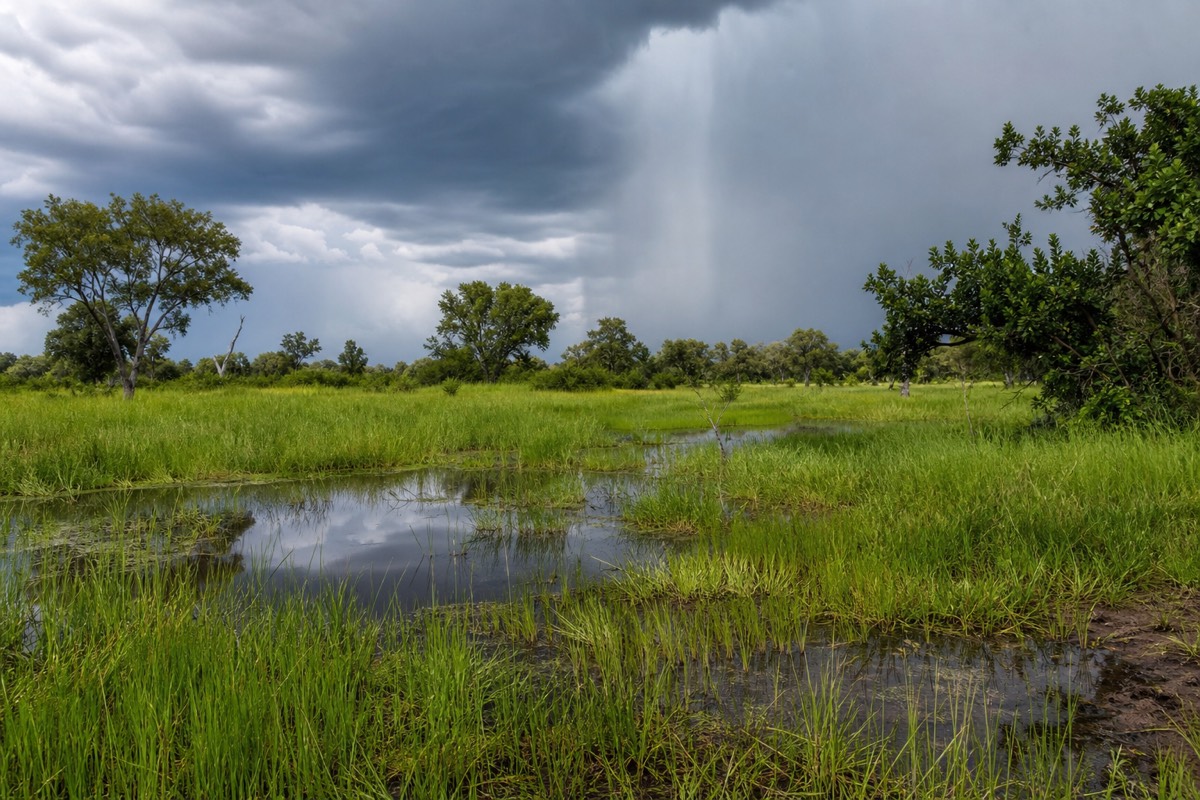
Now hold that next to the second fact: Botswana's own rainy season also runs November to April. The two wet seasons are the same months, in two different places, and only one of them puts water in the delta's channels. Angola's rain becomes Botswana's flood, half a year late. Botswana's rain becomes the green season, which is the low-water end of the calendar even though it is the wet end.
The transit is slow because the two Angolan tributaries drain differently. One runs off harder ground quickly, the other filters through deep sand and peat and releases over months. By the time the pulse crosses into Botswana it has flattened out into something closer to a tide than a flood: the water rises a few centimetres a day and takes weeks to work down through the channel system from the top of the fan to the southern floodplains. Anyone tracking it closely can follow the published flood-cycle timing at this Okavango flood cycle reference, and the annual inundation arriving out of phase with local rain is precisely what the UNESCO listing for the delta singles out as the reason for inscription.
The practical version fits in one line. In the delta, dry means wet.
What is each month in the Okavango Delta actually like?
The year has four moods: green and low from November to April, filling from May, peak flood from June to August, and receding through September and October. Game viewing is strong from May right through October. Birding never has a bad month, it only changes character. The hardest months to book are July, August and September.
| Month | Water level | Game viewing | Birding | Booking pressure | Verdict |
|---|---|---|---|---|---|
| January | Low, local rain falling | Good, animals dispersed | Excellent, migrants in | Easiest of the year | Green season proper. Hot, wet afternoons, lush, best value |
| February | Low | Fair to good, dispersed | Superb, breeding colonies building | Easy | Greenest scenery and the strongest breeding birdlife |
| March | Low, rain easing late in the month | Good | Superb, colonies at full force | Easy | A quiet sweet spot for birders who do not mind humidity |
| April | Low, but the flood is on its way | Good and improving | Very good | Shoulder, day trips easy to arrange | Rain stops, tracks dry, prices still soft |
| May | Rising, the flood arrives | Very good, dry season opens | Very good | Shoulder, same-day day trips realistic | The value month: dry weather without peak pricing |
| June | High and still rising | Excellent | Excellent | Busy, peak pricing begins | Peak water arrives, cold dawns, everything works |
| July | Peak | Excellent, highest density | Excellent | Hardest month of the year | The classic month. Book many months ahead or miss it |
| August | Peak, holding | Excellent | Excellent | Hardest month of the year | As good as July, a shade warmer |
| September | High but receding | Excellent, drying floodplains | Excellent | Very hard | Warmer, superb visibility, still feels uncrowded |
| October | Receding fast, some channels too shallow for a canoe | Excellent on land | Very good | Busy, easing late | Hot and dry. Best land viewing, weakest canoe conditions |
| November | Lowest, local rain begins | Good | Superb, migration peak | Shoulder, bookings realistic | Green season starts. Dramatic skies, arriving migrants |
| December | Low, rain established | Good, dispersed | Superb, migration peak | Easy outside the festive period | Green, hot, good value, excellent birding |
This scorecard is the typical annual pattern and a planning allowance, not a forecast. Water level in any given month depends on the previous Angolan wet season, and it shifts by weeks.
What can you actually do on the water in each part of the year?
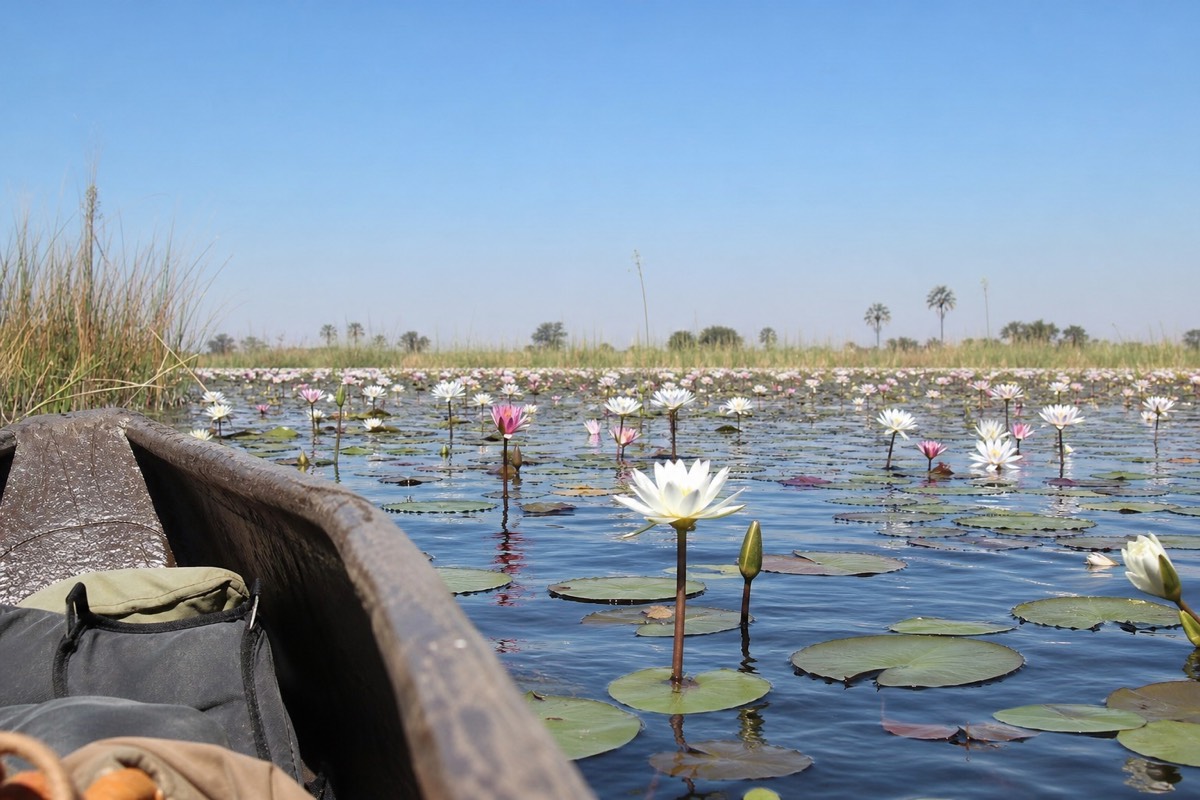
Canoe trips through narrow channels are at their best from June to August and become patchy by late October as channels drop. Motorboat cruising holds up longer because the main channels stay deep. Game drives, walking safaris and birding work all year. The activity that swings hardest with the calendar is the one people come for: the mokoro.
| Activity | May, rising | June to August, peak | September to October, receding | November to April, green |
|---|---|---|---|---|
| Mokoro through narrow channels | Improving week by week | At its best | Patchy, some channels too shallow | Limited in places, varies by year |
| Motorboat cruise on main channels | Good | At its best | Good, deep channels hold | Variable |
| Island walking safari | Good | Good | Good | Good, wet underfoot after rain |
| Open 4x4 game drive | Very good | Excellent | Excellent | Good, some tracks muddy or rerouted |
| Island bush camping | Good | At its best | Good | Hot and humid, less comfortable |
| Birding | Very good | Excellent for concentration | Excellent | Excellent for migration and breeding |
| Scenic flight from Maun | Good | The full flood visible, fills early | Good | Green, with dramatic cloud |
Conditions above are what the operators we work with plan around, not a guarantee for a specific date. Water depth in a specific channel is a local matter, decided by the poler on the day.
If the canoe is the reason you are coming, that top row is your calendar. A full day on the water with community polers works across a wide window because the route can be adjusted, but the deep, narrow, papyrus-walled channels that people picture belong to the high-water months.
How cold is a dawn game drive, and how hot is the middle of the day?
A pre-dawn game drive in the dry winter runs around 8 degrees Celsius on an open vehicle with the wind of movement on top of that, and the same day can reach about 30 degrees by the midday rest at camp. That is a 22 degree swing inside six hours, and it is the single most common packing mistake first-timers make.
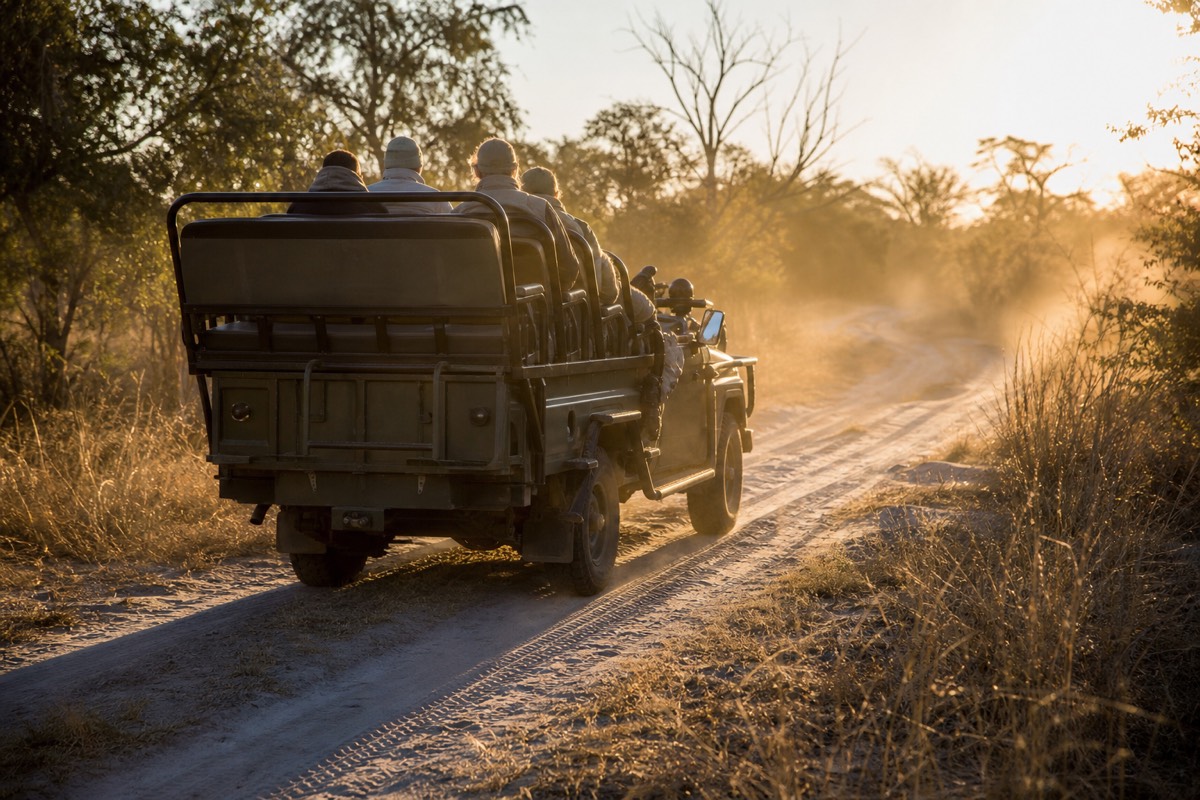
The green season inverts the problem. Days sit in the 30 to 35 degree range with real humidity, dawns are mild rather than cold, and rain arrives as short intense afternoon showers, usually 30 to 90 minutes rather than all-day drizzle. Nobody needs a down jacket in February. Everybody needs one in July.
| Window | Dawn on an open vehicle | Middle of the day | Rain | What that means for layers |
|---|---|---|---|---|
| May to August, dry winter | Around 8 C, sometimes lower | Around 25 to 30 C | Almost none | Fleece or light down plus a wind shell at dawn, shirt sleeves by mid-morning |
| September to October, late dry | Cool, milder than midwinter | Warm to hot | Almost none | Lighter layers. Sun and dust matter more than warmth |
| November to April, green | Mild | 30 to 35 C with humidity | Short afternoon showers, typically 30 to 90 minutes | Quick-dry everything plus a light rain shell |
Temperatures are typical planning figures rather than a forecast for your dates. The full kit list, including why bright colours and hard suitcases are a problem on a charter flight, sits in our note on what to wear and pack for a delta safari.
Is the dry season really better for game viewing, or is that just marketing?
It is real, and the mechanism is simple. As the surrounding country dries out from May onward, standing water disappears everywhere except the delta's permanent channels and lagoons. Animals have to come to the water, so the same population occupies a much smaller area. Concentration, not abundance, is what makes dry-season viewing better.
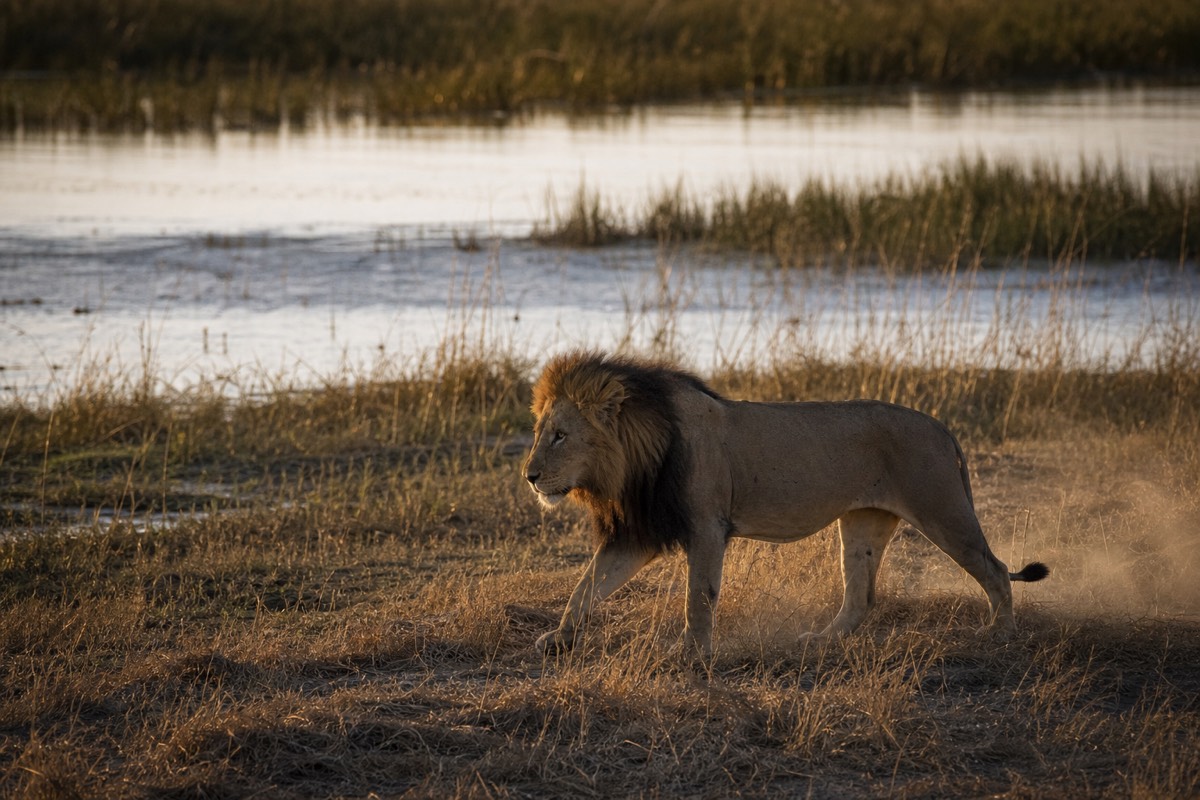
What that looks like on the ground: elephants moving between islands in herds of 50 or more, lions working the floodplain edges at dusk, hippos in the same channels the canoes use, and lechwe wading the shallows in numbers. The delta's most wanted sighting, the African wild dog, ranges through Moremi and Khwai across enormous territories and can be absent for days at a stretch in any month, which no season fixes.
The green season is not bad for wildlife, it is diffuse. Water is everywhere, so animals are everywhere, and a morning drive covers more ground for fewer sightings. Newborn antelope arrive with the rains and predators follow them, which produces the year's most dramatic predator action for anyone patient enough to wait for it. The floodplain edges of Moremi Game Reserve stay productive year round for exactly that reason: the reserve holds a mix of permanent water, woodland and open plain in one place.
Who should genuinely go in the green season, November to April?
Birders, photographers who want weather in their pictures, travellers tied to a December or Easter school holiday, anyone combining the delta with the Kalahari, and anyone for whom the peak-season price is the difference between going and not going. The green season is a real option, not a consolation prize.
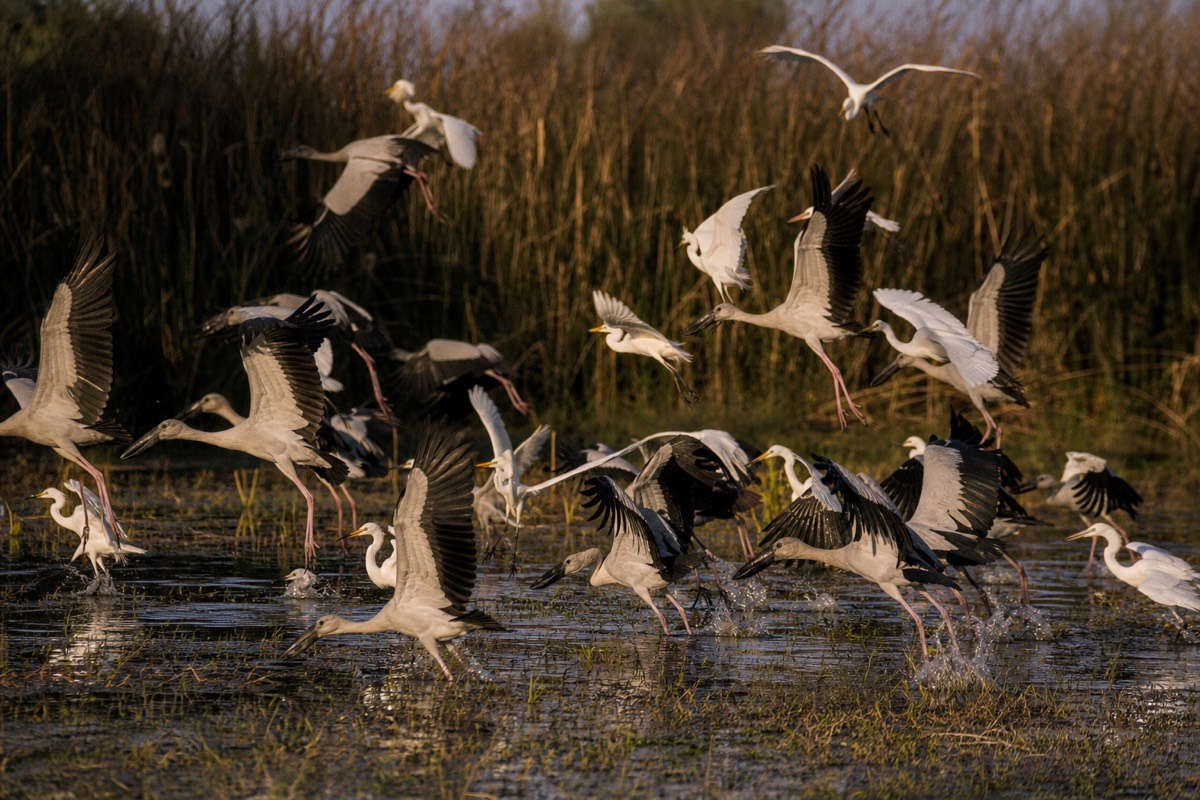
Start with the birds, because it is the strongest argument. The delta holds over 500 recorded species, and the green season brings a mass arrival of migrants from Europe and Asia on top of the residents: waders, swallows, bee-eaters, cuckoos and warblers. Flooded plains fill with nesting storks, herons and ibis. November and December are the migration peak; February and March are when the breeding colonies hit full force.
Then the light. Post-storm skies, rainbows over floodplain, misty mornings and low cloud produce photographs the cloudless dry season simply cannot. Then the price and the space: fewer visitors, easier bookings and lower prices across the board. And then the desert, which is why the three-day Central Kalahari safari out of Maun is the natural green-season pairing. The Central Kalahari runs on the opposite calendar to the delta and is at its best from roughly December to April, when rain flushes the Deception Valley grasslands and the plains game and black-maned lions follow, which makes a Central Kalahari leg the natural green-season pairing rather than an afterthought.
The honest costs of going green: heat and humidity, afternoon storms, some tracks muddy or rerouted, more mosquitoes, and low water that can rule out the deep-channel canoe experience. If that trade sounds like it might tip the balance for you, we set out our honest answer on whether the delta earns its price separately.
How does birdwatching in the delta change through the year?
Both seasons are excellent and they are not the same activity. The dry months concentrate birds onto shrinking water, which makes numbers and hard-to-find specialties easier. The green months bring migration and mass breeding, which makes spectacle and species count higher but individual targets harder to pin down.
| Season | Why it works | What you are looking for | Best months |
|---|---|---|---|
| Dry, May to October | Water recedes, birds concentrate on permanent channels and lagoons; waterbird breeding colonies are active and raptors hunt over drying floodplain | Wattled crane, slaty egret, African skimmer, Pel's fishing owl, white-backed night heron, carmine bee-eater colonies, fish eagle and bateleur | July to September |
| Green, November to April | Migrants arrive in numbers from Europe and Asia, and flooded plains fill with nesting colonies | Waders, swallows, bee-eaters, cuckoos, warblers, open-billed and yellow-billed storks, African openbill, malachite kingfisher | November to December for migration, February to March for breeding |
| Any month | Over 500 species recorded in the delta, with resident waterbirds present year round | Fish eagles, herons, kingfishers, bee-eaters, African jacana | All of them |
Species lists are what the delta is known for rather than a promise for a given week; birding outcomes depend on water level, guide and luck.
How far ahead do you have to book for each month?
July, August and September are the hardest months of the year to find space in, and the site's own standing advice is three to six months minimum for peak season. April to May and November to December are the shoulder windows where same-day and next-day day trips in Maun become realistic. January to March is the easiest.
The reason is capacity, not popularity. The whole delta carries roughly 1,000 to 1,500 beds across every private concession and camp combined, and that number is fixed by conservation licence rather than by demand. When the peak-season beds are gone, they are gone, and no amount of budget produces more of them.
| Window | How hard to book | What goes first | Realistic lead time |
|---|---|---|---|
| July to September | Hardest of the year | Inner-delta concession camps, the community canoe camping dates, the 45-minute scenic flight | Many months. Three to six is the standing advice |
| June and October | Busy | Peak-water camp space and mobile safari departures | Several months |
| April to May | Shoulder | Little. Day trips from Maun can often be arranged same-day or next-day | Weeks, sometimes days |
| November to December | Shoulder, tighter over the festive period | Festive-week space in the better camps | Weeks |
| January to March | Easiest | Almost nothing, though the best guides get taken | Weeks |
Lead times reflect the pattern the operators we work with report; the live listing carries current availability for any specific date.
Lead time also depends on what kind of bed you want, because a mobile tented camp, a permanent concession camp and a lodge on the delta's edge fill on different schedules. We compare them in the guide to camps, lodges and mobile tented camps.
How much does the flood timing vary from year to year?
By several weeks in either direction, and occasionally more. The flood depends on how much rain fell in Angola the previous summer, so a strong year fills channels early and a weak one leaves them low into June. Nobody publishes a reliable forecast, which is why you should not build a canoe-dependent itinerary on the very edge of the season.
In practice that means two specific traps. The first is early May: the flood is arriving, but in a slow year the narrow channels the mokoro needs may not be open yet. The second is late October: the water is dropping fast, and channels that carried a canoe in September can be too shallow four weeks later. Both months are excellent for a safari. Neither is a safe bet if the entire point of the trip is deep-channel poling.
The way around it is not to gamble, it is to book a format that carries its own margin. Multi-day trips that combine canoe, motorboat and open 4x4 keep working whatever the water is doing, because the guide moves the activity mix rather than cancelling. Community-run island camping on the accessible side of the delta is another sturdy choice in the shoulder, and two nights camping on a delta island gives dawn canoe sessions and afternoon walking safaris across a broad span of the year rather than a single narrow window.
If you can only travel in one particular month, what should you book?
Every month in the delta is worth going. What changes is which format suits it. The mistake is not travelling in the wrong month, it is booking a peak-season itinerary and taking it into a green-season delta, or the reverse.
| Your only window | The honest situation | Book this | Do not build the trip around |
|---|---|---|---|
| January to March | Green, hot and humid, lowest water, quietest | Game drives in Moremi and Khwai, a Central Kalahari leg, serious birding | A long canoe-dependent route deep in the channels |
| April | Rain stopping, tracks drying, flood on its way | A day canoe trip from Maun plus multi-day drives | Guaranteed high water |
| May | Flood arriving, dry weather, prices still soft | Almost anything. This is the value month | The very top of the flood |
| June to August | Peak water and peak wildlife at the same time | Inner-delta camps, multi-day canoe camping, boat cruises | Booking late |
| September to October | Water receding, land viewing at its best | Concession game drives, motorboat on the main channels | Narrow-channel canoe routes late in October |
| November to December | Green season opening, migration peak, dramatic skies | Birding, photography, shoulder-priced multi-day trips | Cold-weather packing you will never use |
These are planning allowances built on the typical pattern, not operator promises for a specific date.
Length matters as much as month, and a short trip in a good month beats a long one badly planned. Our note on how many days the delta actually needs covers where the returns start diminishing.
Peak season or green season: the straight comparison
Peak season buys water, concentration and cold clear mornings at the highest price and the tightest availability. Green season buys birds, weather, space and a softer price, at the cost of heat, humidity and low channels. There is no third option that gets both.
| Factor | Peak, June to October | Green, November to April |
|---|---|---|
| Water | Highest, spreading to about 15,000 km2 at the top of the flood | Lowest, around 6,000 km2 of permanent wetland |
| Weather | Dry, dawns near 8 C, days around 25 to 30 C | Hot and humid, 30 to 35 C, short afternoon storms |
| Game viewing | Animals concentrated on the remaining permanent water | Animals dispersed across green country |
| Birding | Best for concentration and specialties | Best for migration and breeding colonies |
| Water activities | At their best | Variable, channel by channel |
| Malaria transmission | Present but lower | Peak transmission season |
| Availability and price | The busiest and priciest end of the year | Quietest, lower prices, easiest to book |
| Scenery | Dry, dusty, high contrast, big herds on open ground | Green, flowering, dramatic skies |
A comparison of typical conditions rather than a guarantee; any single year can behave differently.
What about rain, mosquitoes and malaria in the green season?
Rain rarely cancels anything. Green-season showers are short and intense, usually 30 to 90 minutes in the afternoon, and morning activities normally run as planned. Malaria is the real seasonal health consideration: transmission peaks in the rainy season, roughly November to April, and the risk is present year round in northern Botswana at a lower level in the dry months.
Botswana's malaria-risk districts include Ngamiland, which is Maun and the Okavango Delta, and Chobe. The Central Kalahari does not appear in the high-risk list, and there is no transmission in Gaborone. We cover how safe an Okavango Delta safari really is alongside the wildlife side of the same question. Chemoprophylaxis is recommended for travel to the listed districts and there are several options, but which one you take and when you start it is a decision for a doctor or travel clinic, not for a website. Bite prevention applies in every month: DEET-based repellent from late afternoon through after dark, all year, is what the guides do themselves.
Confirm the current picture against the CDC travel health page for Botswana before you travel, because recommendations change. The entry side of the paperwork, including who enters visa-free and what children need, sits in our guide to Botswana travel requirements, visas and malaria. Treat all of it as planning information rather than medical or immigration advice.
What we tell first-timers who are choosing a month
Pick the month for what you want to do, then book the format that survives that month's water level, then book it early enough to get the part of the delta you chose. In that order. Most disappointment here comes from booking the right month too late, not from choosing the wrong month.
If the calendar is open, take the second half of June or the first half of September: nearly all of the peak-season benefit, slightly less pressure on availability than the middle of July. If July or August is the only option, treat the booking as urgent rather than flexible, because the good concession camps, the community canoe camping dates and the 45-minute scenic flight all fill ahead in exactly those weeks. If the only option is January, go anyway, and go for the birds and the drives rather than the channels.
What the trips we list bundle is the awkward part of any month: the charter or road transfer, the park fees, the camp, the guiding and the meals in a single price, which is the set of pieces that becomes hard to assemble late in the peak. For anyone who wants the full seasonal range in one trip, seven days across Moremi, Khwai, Mababe and the inner delta covers canoe, motorboat and open 4x4 in one itinerary, which is the format least exposed to whatever the flood decides to do that year. The delta will be extraordinary whenever you come. The month decides which version of it you get.