Central Kalahari Game Reserve: What to Know Before You Go
The Central Kalahari runs on the opposite calendar to the Okavango Delta: it comes alive in the summer rains, December to April, when the delta is at its lowest and quietest. That single inversion decides almost every planning question about the reserve.
A three-day Kalahari camping safari starts from Maun and visits Deception Valley. A delta canoe day is a separate addition, with different terrain and seasonal conditions. Explore Three-Day Central Kalahari Safari
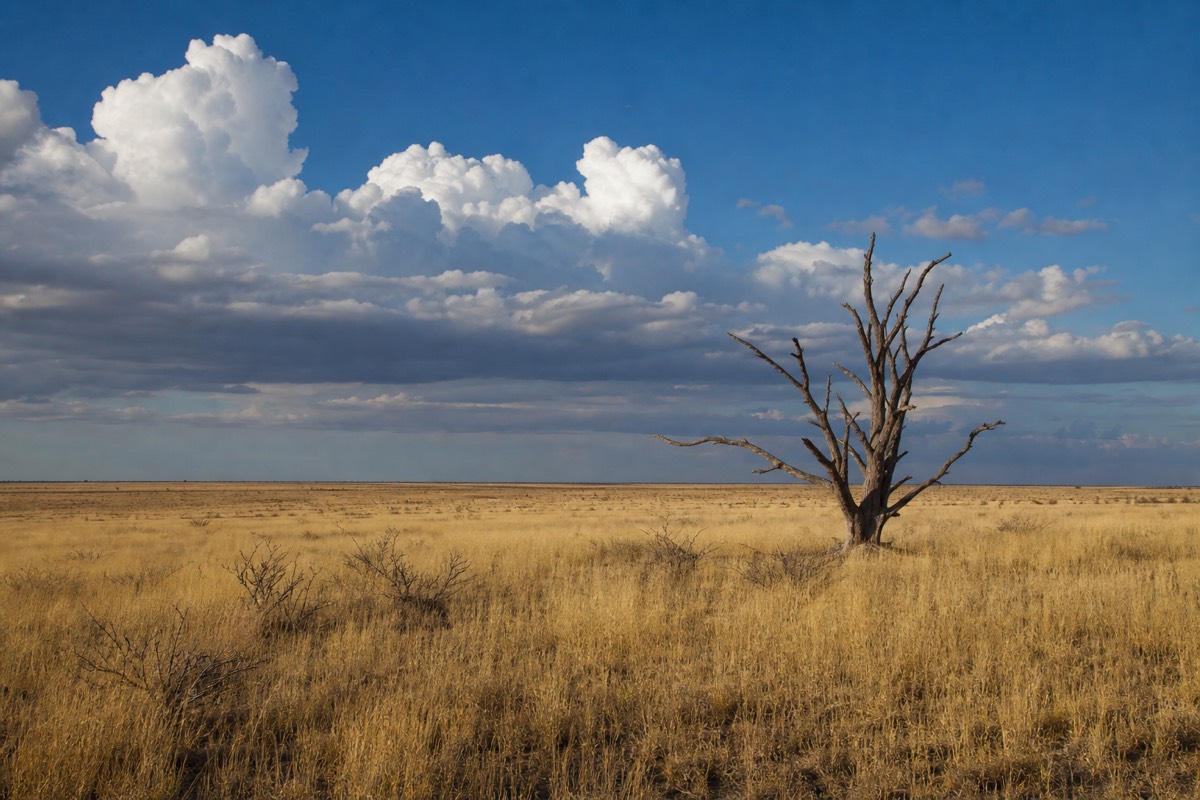
The Central Kalahari Game Reserve covers 52,800 square kilometres, which makes it larger than several countries and one of the biggest game reserves anywhere on earth, commonly ranked second largest. It was established in 1961 and it is still almost entirely undeveloped: no tarred roads, no towns, no fences you would notice, and long distances between any two reliable waterpoints. What matters most for planning, though, is not the size. It is the calendar. The Kalahari is at its best in the green season from roughly December to April, which is precisely when the Okavango Delta is at its lowest water and least visited, and that inversion is the reason Okavango Delta Botswana Tours treats the two as a pair across a year rather than a pair inside one trip.
The Kalahari and the delta peak at opposite ends of the year
The bands show the typical pattern our team plans around, not a forecast. The Angolan rain that becomes the delta flood falls in the same November to April window as Botswana's own rain, but the water takes months to arrive, which is why the two peaks land half a year apart.
What is the Central Kalahari Game Reserve?
The Central Kalahari Game Reserve is a 52,800 square kilometre reserve in the middle of Botswana, established in 1961 and among the largest protected areas on the planet. It is semi-arid grassland and fossil river valley rather than desert dune, and it carries almost no infrastructure: this is the emptiest large landscape most visitors will ever stand in.
The word desert misleads people. The Kalahari is a sand basin covered in grass, scrub and scattered trees, and after summer rain parts of it turn genuinely green. What it lacks is surface water. There are no permanent rivers inside the reserve, which is why the game moves with the rain instead of concentrating around a channel the way it does in the delta or on the Chobe river.
The landmarks people come for are the fossil valleys, ancient river courses that no longer carry water but still hold better grass than the surrounding sand. Deception Valley is the best known, and our own 3-day Central Kalahari safari from Maun is built around it: an early departure from Maun to Deception Valley, an afternoon game drive and sunset over open grassland, then a second day working Sunday Pan and Passarge Valley before a dawn drive on day three. That routing exists because those valleys are where the animals are.
Scale is worth sitting with for a moment. At 52,800 square kilometres the reserve is more than four times the size of Chobe National Park and larger than the entire inscribed Okavango Delta property. You can drive for hours inside it and see no vehicle, no building and no track other than your own.
Why is the Kalahari at its best when the delta is at its weakest?
Because the Kalahari runs on local rain and the delta runs on borrowed water. Botswana's rains fall from November to April, flushing the Deception Valley grasslands and pulling plains game and their predators onto the new grass. The delta's flood, by contrast, arrives from Angola in May and June and peaks in July and August, months after the local rain has stopped.
This is the single most useful fact in this guide. Two destinations three hundred kilometres apart peak six months apart, for reasons that have nothing to do with each other. The Kalahari is a rain-fed system: grass grows where water falls, and the herbivores follow the grass within weeks. The delta is a flood-fed system: water falls in another country and takes months to arrive, so the wet season on the ground and the high water in the channels are separate events.
For a traveller that produces a clean rule. If your dates are in January, February or March, the Kalahari is the strong choice and the delta is the quiet one. If your dates are in July or August, reverse it. If your dates are in May or November, both are decent and neither is at its best, which is also when both are easiest to book.
The trap is trying to have both peaks in one trip. You cannot. A single visit lands in one half of the year, and one of the two destinations will be off-peak. That is not a disaster, and the section on combining them below explains what a sensible compromise looks like, but it is worth knowing before you fix your dates.
How does the delta's own flood cycle work, and why is it out of phase?
Rain falls in the Angolan highlands from November to April, drains into the Cubango and Cuito rivers, and travels roughly 1,200 kilometres down a river system about 1,500 kilometres long. It reaches Botswana in May and June and peaks in July and August, in the middle of Botswana's own dry season. Around 11 cubic kilometres of water enters each year and roughly 97% of it evaporates rather than flowing out.
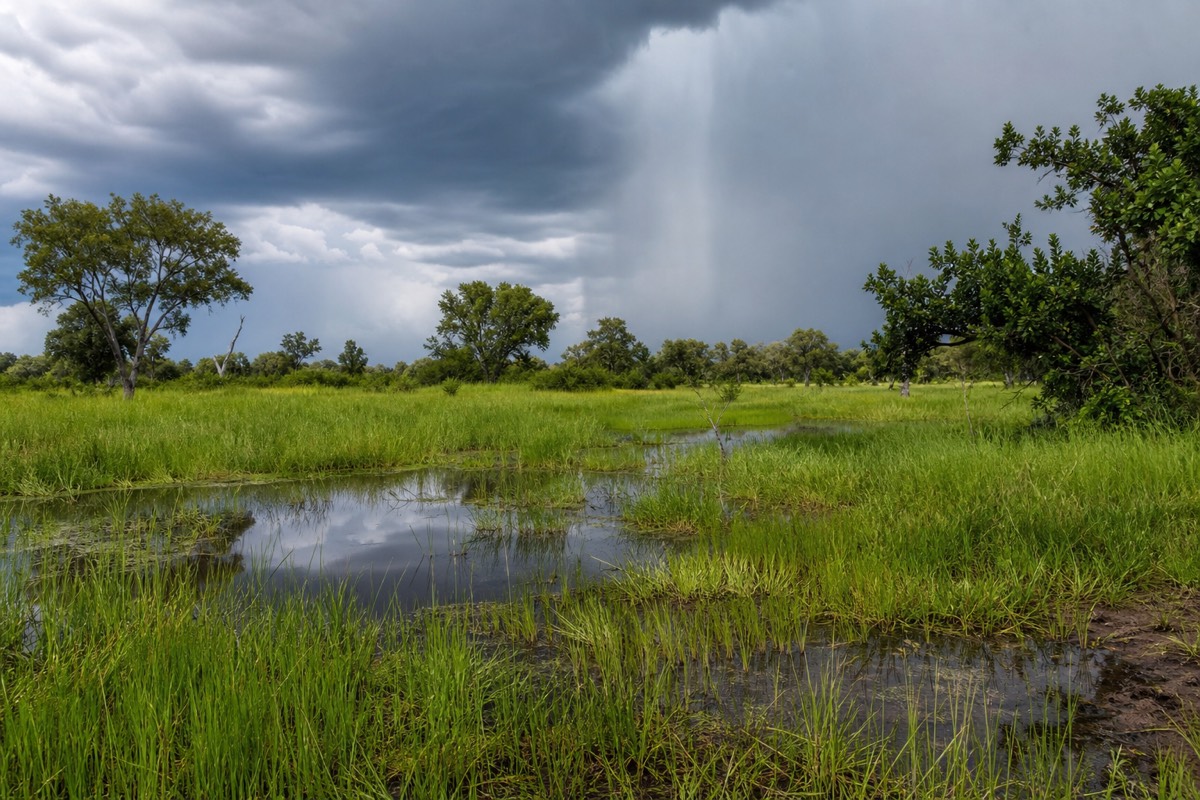
So the delta floods when the surrounding country is driest. Full channels and concentrated wildlife arrive together, which is why June through August is the delta's water season and its game season at the same time. Independent references such as the flood-cycle timing record track how far the arrival shifts from one year to the next, and it can be several weeks either way.
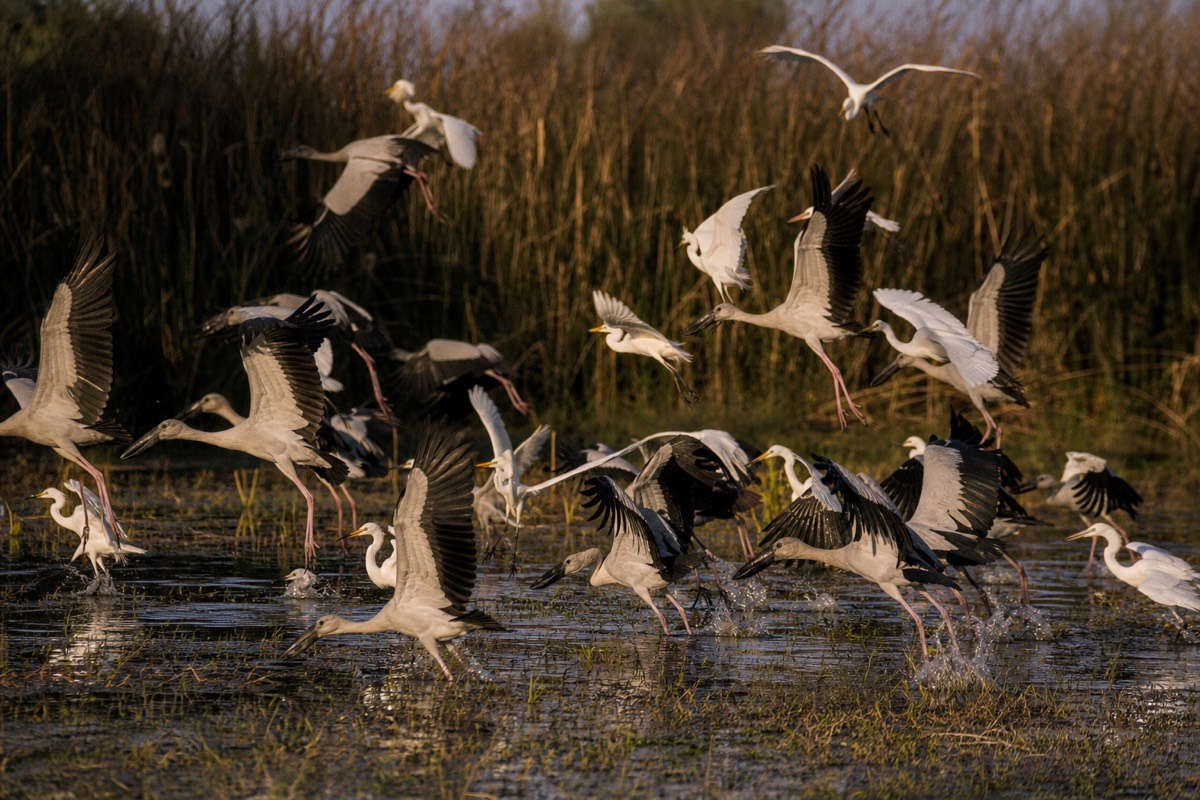
Botswana's own November to April rain does something different in the delta. It adds water to a system that is already emptying, greens the islands, brings migratory birds in large numbers, and drops prices. That is the green season, and it is the delta's low-water end of the year, not its high-water one. Confusing the two rainy seasons is the most common mistake we see in trip plans. The month-by-month guide to the best time to visit the Okavango Delta untangles it, and the geography guide to where the delta sits covers the basin and the flood path.
What does the green season look like on the ground in Deception Valley?
After the first real rains, usually from December, the pans hold shallow water and the fossil valley grass comes up fast. Springbok, gemsbok, wildebeest, hartebeest, eland and giraffe move onto it, and the predators follow. Our own itinerary notes plainly that the grasslands are at their best after the rains.
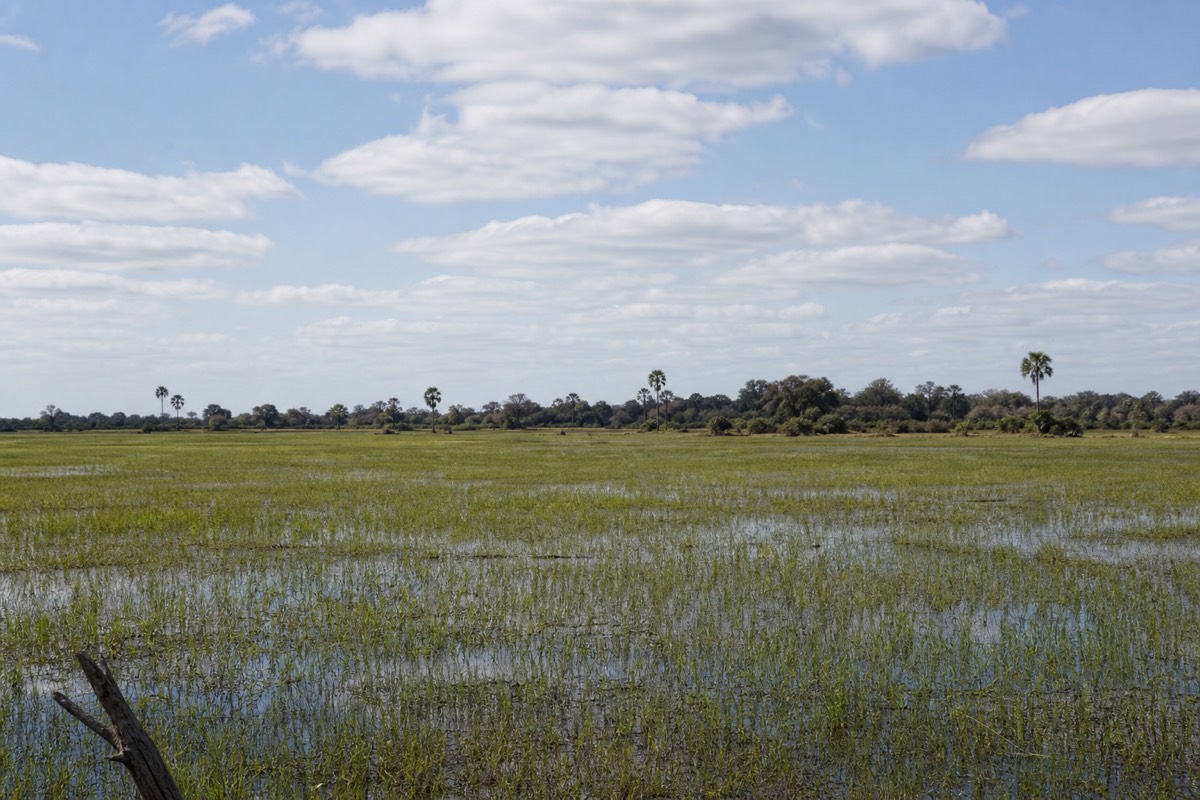
What you notice first is the sky. In the wet months the Kalahari produces enormous cloud structures, late-afternoon storms that move across a horizon you can see for tens of kilometres, and light that photographers plan whole trips around. The grass is pale gold turning green, and the pans go from cracked white to reflective sheets.
The second thing you notice is the quiet. There is no water noise here, no hippos, no frogs, nothing like the delta's constant soundtrack. Nights are dark in a way that surprises people, with almost no light pollution for hundreds of kilometres.
Be realistic about the rain itself. Summer afternoons bring short heavy showers rather than all-day weather, and temperatures run hot. Sand tracks that were easy in September get soft and rutted, and some routes become genuinely difficult. That is the trade you make for the grass and the game.
Which month should you actually go?
December to April is the Kalahari's window, with February and March often the strongest for grass and plains game, and March to April giving slightly easier driving as the heaviest rain eases. June to September is the reserve's weakest stretch, cold at dawn, dry, and with the game dispersed. The table below sets both destinations side by side.
| Month | Central Kalahari | Okavango Delta | Which to prioritise |
|---|---|---|---|
| January | Peak: grass up, pans holding water, predators active | Green season: low water, lush, excellent birding | Kalahari |
| February | Peak: often the best grass of the year | Green season, breeding bird colonies | Kalahari |
| March | Peak: strong game, rain easing | Green season, water still low | Kalahari |
| April | Good: grass drying, tracks firming up | Flood beginning to arrive, shoulder pricing | Either |
| May | Fading: game starting to disperse | Water rising, dry season opens | Delta |
| June | Quiet: cold dawns, dry, dispersed game | Water rising fast, mokoro access opening | Delta |
| July | Quiet: coldest nights of the year | Peak flood, densest game, hardest to book | Delta |
| August | Quiet: dry and dusty | Peak flood, best water activity | Delta |
| September | Quiet: hot, dry, low density | Water receding, game viewing still excellent | Delta |
| October | Building: very hot, first storms possible | Channels shallowing, strong land safaris | Delta |
| November | Good: rains arriving, grass responding | Green season begins, prices soften | Either |
| December | Peak begins: grass up, game moving in | Green season, low water | Kalahari |
Rain timing moves by weeks from year to year, so treat the boundaries of these windows as approximate rather than fixed dates.
What wildlife can you realistically expect to see?
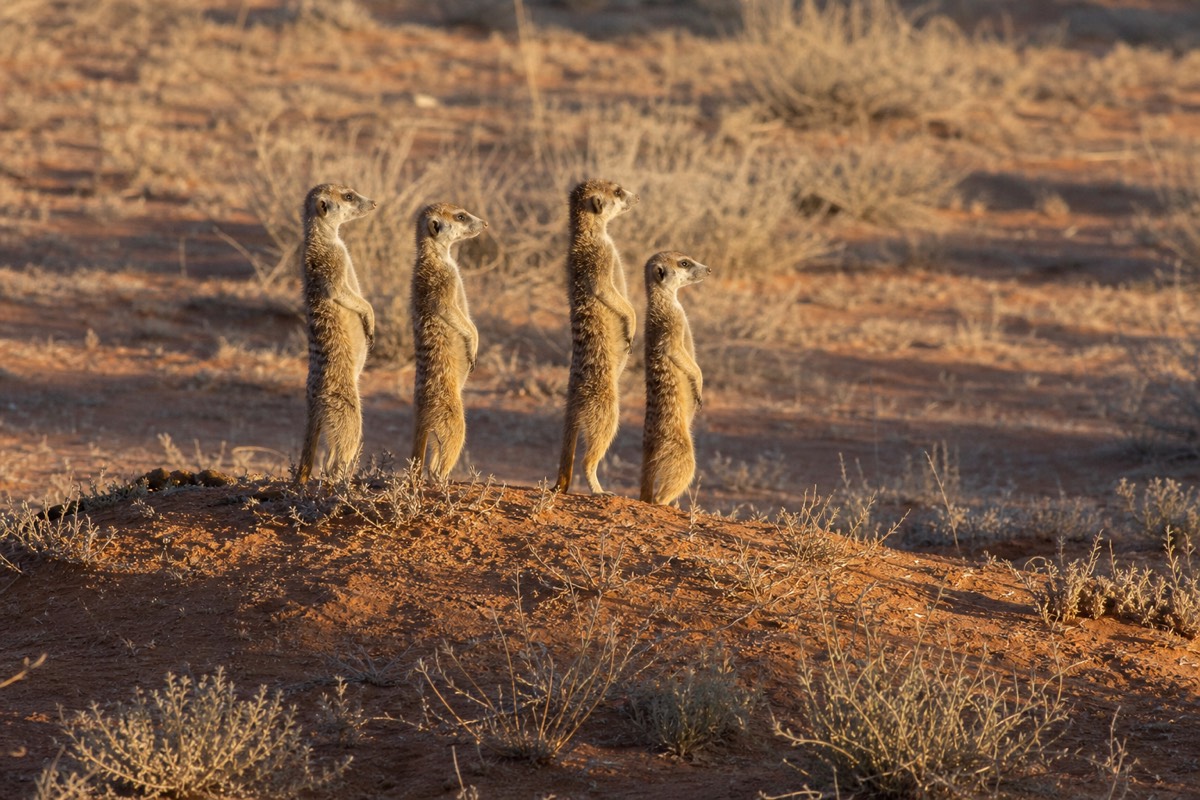
Plains game first: springbok, gemsbok, wildebeest, hartebeest, eland and giraffe, at their best after the rains. Then the predators that follow them, including the black-maned Kalahari lions the region is known for, cheetah on the open pans, and leopard. Brown hyena and meerkats are Kalahari specialities. Game density is far lower than the delta's, and sightings are earned rather than delivered.
That last sentence is the honest core of this section. In the delta in August, animals are concentrated around the only water for miles and a morning drive is productive almost by default. In the Kalahari, animals are spread across an area more than four times the size of Chobe National Park, and a morning can pass with grass, sky and a distant oryx. When it does deliver, it delivers something the delta cannot: cheetah hunting across open ground with nothing to block the view, or a black-maned lion walking a pan edge at dawn.
Our 3-day itinerary reflects that reality in its structure. Day one and day two work the valleys and pans where the grazers gather. Day three starts with a dawn drive specifically aimed at cheetah, lion and leopard, because first light is when the odds are best, then returns to Maun by mid-afternoon.
| Species | Green season, Dec to Apr | Dry season, Jun to Sep | Where to look |
|---|---|---|---|
| Springbok and gemsbok | Strong, in numbers on the new grass | Present but dispersed | Deception Valley, Sunday Pan |
| Wildebeest, hartebeest, eland | Strong after rain | Much harder to find | Fossil valley grasslands |
| Giraffe | Best after the rains | Occasional | Tree lines and valley edges |
| Kalahari lion | Follows the grazers; black-maned males are the regional signature | Wide-ranging, low odds | Pan edges at dawn and dusk |
| Cheetah | Realistic on open pans | Possible, thinly spread | Open ground, early morning |
| Leopard | Present, elusive | Present, elusive | Wooded valley margins |
| Brown hyena | A Kalahari speciality, mostly nocturnal | Same, low odds either way | Around camp and pans after dark |
| Meerkats | Reliable at known colonies | Reliable at known colonies | Open sandy ground |
These are typical patterns from the areas our operators work, not guarantees. The Kalahari rewards patience and several days more than it rewards a tight schedule.
Whose land is this?
The Central Kalahari is the ancestral land of San communities, and their relationship with the reserve has been the subject of long-running legal and political dispute in Botswana. We state that plainly because it is true and because visitors deserve to know whose country they are travelling through.
Beyond that we do not go. The dispute is a matter of Botswana's own courts and politics, not something a tour listing should summarise or take a position on, and it is certainly not a visitor attraction. If you want to understand it properly, read it from primary sources and from the communities themselves rather than from a safari page.
What this does mean practically is that the reserve is not empty land in the way a brochure photograph implies. Treat guides' guidance on where to go and what to photograph as binding, and do not treat people as scenery.
How do you get to the Central Kalahari from Maun?
Maun is the practical gateway. Our 3-day Central Kalahari safari departs Maun early on day one, drives to Deception Valley, camps two nights and returns to Maun on day three by mid-afternoon. That guided road trip is the straightforward way in, and it needs no charter flight.
Maun itself is reached by Air Botswana from Gaborone and Kasane, Airlink from Johannesburg and Cape Town, and CemAir from Johannesburg, with the Johannesburg leg running about an hour and a half to two hours. The guide to Maun as a gateway town covers the airport, where transfers leave from and what a night in town is actually like, which matters because most Kalahari trips start with one.
Fly-in access to the reserve exists through lodge airstrips, but it is not the format we sell and it is not the cheaper option. For most travellers the choice is between a guided road safari and driving yourself, and the second of those is a much more serious undertaking than people expect.
| Option | How it works | Suits | Main constraint |
|---|---|---|---|
| Guided road safari from Maun | Early departure, vehicle, guide, camp, catering, park fees handled | Most visitors, including first-timers | Fixed itinerary and dates |
| Fly-in to a lodge airstrip | Light aircraft to a private lodge inside or near the reserve | Travellers short on time with budget to match | Cost, and the same charter baggage limits as the delta |
| Self-drive, fully equipped | Your own high-clearance 4WD, all fuel, water, food and recovery gear | Experienced sand drivers travelling in convoy | Deep sand, long distances, no facilities |
| Mobile operator with your own group | Private guided camping trip, tailored route and dates | Families and groups wanting flexibility | Needs planning lead time |
Which of these is available depends on the month and on lead time; peak green-season dates and vehicles book out in advance like everything else in Botswana.
Is self-driving the Central Kalahari realistic?
Only if you are genuinely equipped and experienced. The tracks are deep sand, the distances between waterpoints are long, there are no fuel stations, no shops and no reliable phone signal inside the reserve, and you must carry all your own fuel, water, food and recovery equipment. This is not a national park you drive through on the way somewhere.
People underestimate it because the map looks empty and the roads look short. Sand driving at low pressure eats fuel at a rate that surprises first-timers, a stuck vehicle with no second vehicle is a serious situation, and summer heat compounds every mistake. Botswana's Department of Wildlife and National Parks administers the reserve and its campsites, and self-drivers should confirm current requirements, bookings and fees directly through official channels; the Government of Botswana portal is the place to start.
If you are still weighing it, work through this honestly. A no on any line in the top half of the table is a reason to take the guided trip instead.
| Requirement | Why it matters | Non-negotiable? |
|---|---|---|
| High-clearance 4WD with low-range | Deep sand tracks, no graded roads | Yes |
| Long-range fuel, plus jerry cans | No fuel inside the reserve; sand driving roughly doubles consumption | Yes |
| Water for every person and day, plus a reserve | No water source you can rely on | Yes |
| Recovery gear and the skill to use it | Getting unstuck is your own problem | Yes |
| Satellite communicator or radio | Phone coverage is unreliable to absent | Yes |
| Second vehicle in convoy | The single biggest safety upgrade available | Strongly advised |
| Pre-booked campsites and permits | Sites are limited and administered, not first-come | Yes |
| Full self-catering and cold chain | No shops, no restaurants, nothing | Yes |
| Tyre repair kit, compressor, two spares | Thorn punctures are routine | Strongly advised |
This is a planning checklist rather than a licence: conditions vary by season and route, and local advice on the week you travel beats any list.
What does it cost, and what is included?
Our 3-day Central Kalahari safari from Maun starts at $1,375 per person, with the current price on the live listing. Multi-day prices on this site are per person and cover accommodation, meals, park fees, transfers and guiding unless the listing says otherwise, which removes the fee question entirely for anyone booking a trip.
On park entry fees for self-drivers we are going to be honest rather than helpful: the current non-resident figure is genuinely ambiguous. A government news item has referenced a proposed increase for April 2026 while a separate departmental release said no new fees had been implemented as of March 2026. We are not going to publish a number we cannot stand behind. Confirm the current schedule with the Department of Wildlife and National Parks before you travel.
What the guided trip actually removes from your plate is worth listing, because the value is in the logistics rather than the luxury. There is no lodge here in the delta sense; this is proper bush camping with a guide, a vehicle and a cook fire.
| Item | Guided 3-day trip from Maun | Self-drive equivalent |
|---|---|---|
| Vehicle and fuel | Included | Your cost, and sand driving is thirsty |
| Park fees | Included in the listed price | Your responsibility, confirm current rates officially |
| Camping and equipment | Included, set up for you | Yours to carry, pitch and book |
| All meals and water | Included, catered | Full self-catering, plus a water reserve |
| Guide and tracking knowledge | Included, the main reason sightings happen | You are the guide |
| Route decisions | Made on the day by someone who knows the pans | Yours, with limited information |
| Recovery and breakdown risk | Operator's problem | Entirely yours |
Prices are starting prices at the time of writing; check the live listing for the current figure and what the specific departure includes.
Do you need malaria tablets for the Central Kalahari?
The Central Kalahari is not on the CDC's list of high-risk malaria districts for Botswana, unlike Maun, Ngamiland and Ngami, the Okavango, and Chobe, which are. That is a real and useful difference, but it does not cover the whole trip: almost every Kalahari itinerary starts and ends in Maun, which is in a listed district.
So the practical question is not about the reserve, it is about the trip. If your route is Johannesburg, Maun, the Kalahari and back, you have spent time in a listed area regardless of where the safari itself took place. The CDC's own Botswana travel health page is the primary source and requirements change, so read it rather than relying on a tour page, and take the decision to a doctor or travel clinic. Which medication, and when to start it, is their call and not ours.
Bite prevention applies wherever you are. Our standing advice is DEET-based repellent from late afternoon through after dark, year round, plus long sleeves and trousers in the evening. The full requirements picture, including visas, passport validity and the documents families need, sits in the guide to Botswana travel requirements, visas and malaria.
One seasonal note that interacts awkwardly with this article: malaria transmission in Botswana peaks in the rainy season, roughly November to April, which is exactly the Kalahari's best window. The reserve itself is not in a high-risk district, but the Maun bookends of the trip are, and that is worth raising with your clinic when you tell them your dates.
How big is it compared with Moremi, Chobe and the delta?
At 52,800 square kilometres the Central Kalahari is more than four times the size of Chobe National Park, more than ten times the size of Moremi Game Reserve, and larger than the entire inscribed Okavango Delta property of 2,023,590 hectares. Almost none of that area carries infrastructure, which is the part that changes how a trip feels.
| Area | Size | Established | Status |
|---|---|---|---|
| Central Kalahari Game Reserve | 52,800 sq km | 1961 | Game reserve, commonly ranked second largest on earth |
| Okavango Delta, inscribed property | 2,023,590 hectares, about 20,200 sq km | Listed 2014 | UNESCO World Heritage Site 1432 |
| Okavango Delta, flooded extent | About 6,000 sq km dry season to 15,000 sq km at peak | Seasonal | Moremi plus concessions on tribal land |
| Chobe National Park | 11,700 sq km | 1967 | Botswana's first national park |
| Moremi Game Reserve | 5,000 sq km | 1963 | About 40% of the inscribed delta property |
Sizes are the standing published figures; the delta's flooded extent is a genuine range because it changes through the year. The Moremi Game Reserve guide covers what the delta's one formal reserve gives you, and the comparison of Chobe against the Okavango Delta handles the two northern options against each other.
Who should go, and who should skip it?
Go if you have already done a water-based delta trip, if your dates fall between December and April, if you want landscape and space more than a species checklist, or if you are a photographer drawn to open ground and big skies. Skip it if this is your only African safari, your dates are in July or August, or you need reliable sightings inside three days.
The larger group is the skip group, and we would rather say so. A traveller with one week in Botswana in August, on a first safari, will get more out of the delta and Chobe than out of the Kalahari, because those places concentrate wildlife exactly when that traveller is there. Sending them to the Kalahari in August would be selling them the reserve at its weakest.
| Traveller | Verdict | Reason |
|---|---|---|
| First African safari, one week, July or August | Skip | Kalahari is off-peak; the delta and Chobe are at their best |
| Second or third Botswana trip | Go | Structurally different from anything the delta offers |
| Travelling in January to March | Go | The reserve's strongest window, and the delta's quietest |
| Landscape and night-sky photographer | Go | Open horizons, storm light, near-zero light pollution |
| Wants the Big Five ticked | Skip | Wrong ecosystem; density is low and there is no water to concentrate game |
| Family with young children | Usually skip | Long sandy drives, hot days, basic camping, sparse sightings |
| Experienced self-drive overlander | Go, prepared | One of the great self-drive routes in Africa if you are equipped for it |
| Three days total in Botswana | Skip | A delta day trip or an overnight mokoro gives more per day |
Use this as a starting point rather than a ruling; dates and previous safari experience move the answer more than anything else on the list.
Can you combine the Kalahari and the delta in one trip?
Yes, and Maun makes it easy logistically. The calendar is the problem, not the geography. Whatever month you pick, one of the two will be off-peak, so decide which destination is the reason for the trip and let the other be the contrast rather than the co-headline.
The workable shape is a delta-led trip in the dry season with a short Kalahari add-on, or a Kalahari-led trip in the green season with a delta day trip or short mokoro overnight attached. Both start and end in Maun, which removes the transfer problem entirely.
A concrete dry-season version: three nights in the delta on the 4-day private-concession delta safari from $1,270 per person, then the 3-day Kalahari trip from Maun, giving you high water, dense delta game and the desert contrast inside about a week. The Kalahari will not be at its peak in July, and you should go in knowing that.
A green-season version reverses it: the Kalahari at its best in February or March, plus a delta mokoro day or overnight while the channels are low, birdlife is at its loudest and prices are softer. If you want the delta at full length instead, the 7-day Moremi and inner delta safari from $1,890 spends six nights across Moremi, Khwai, Mababe and the inner delta, and pairs better with a separate Kalahari trip in a different year than with a rushed add-on. On how much time each place needs, the breakdown of how many days the Okavango Delta warrants is the honest place to start.
Two practical notes for either version. Pack for a wider temperature range than you expect: dawn on a Kalahari game drive in June is genuinely cold, and midday in February is genuinely hot, which the packing guide for a Botswana safari works through in detail. And book early: the trips we list bundle the vehicle, the guide, the camping, the meals and the park fees into one confirmed booking, and green-season Kalahari departures and peak-season delta space both go months ahead.